

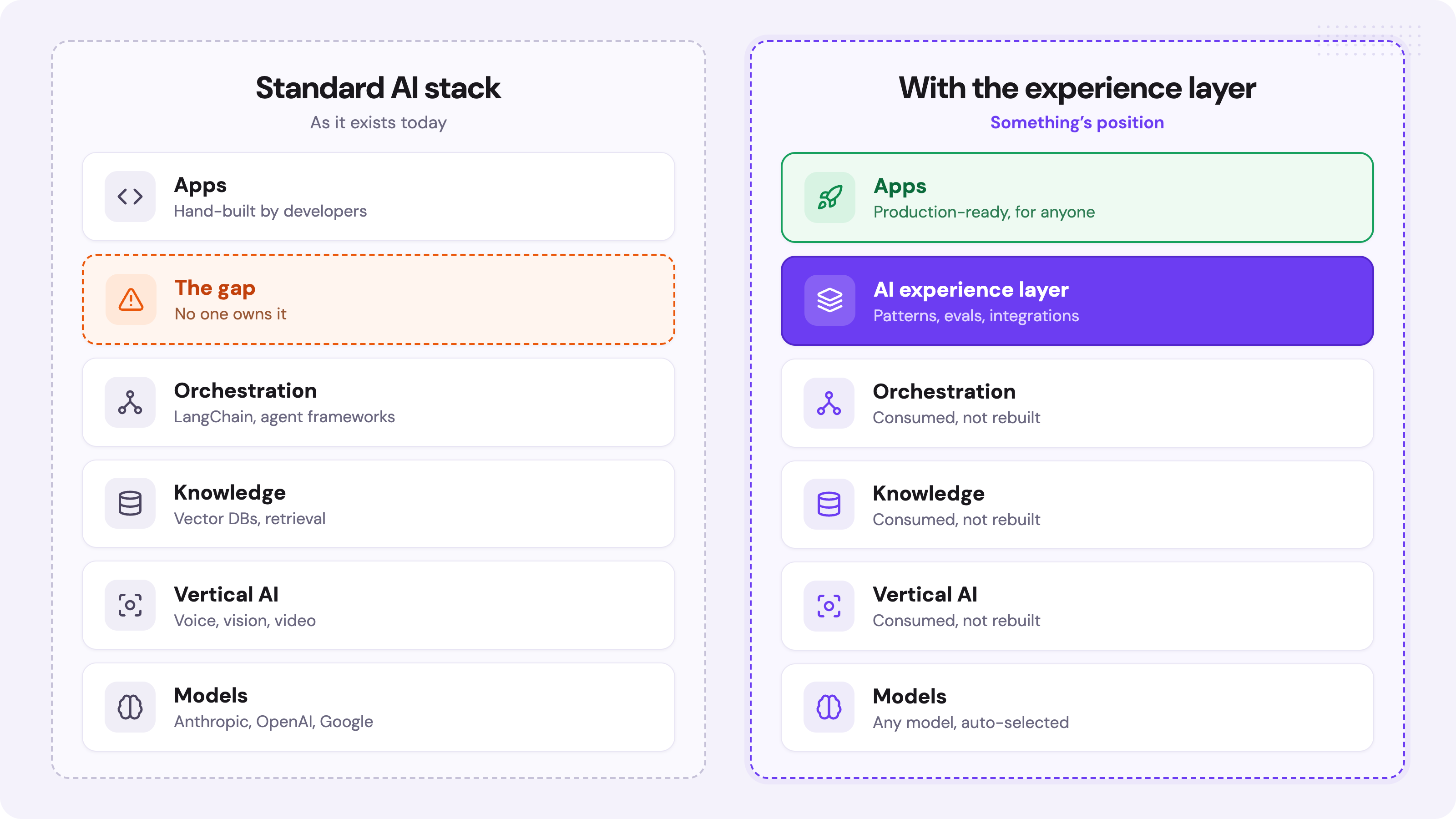
The AI experience layer is missing. We’re building it.
The modern AI stack has models, orchestration, integrations, voice, vision, hosting, and increasingly capable agents.
What it still doesn't have is the layer that turns all of those pieces into a finished application.
We call that the AI experience layer.
It sits above the models, orchestration frameworks, and vertical AI services — and turns their raw capability into complete, production-ready apps that anyone can create by describing an outcome in plain English.
It is not customer experience software. It is not the "experience layer" that enterprise suites bolt onto their own products. And it is not another code generator.
It's the horizontal layer that learns what great AI-native apps look like — and builds every new app from that knowledge.
We're building it.
Here's why we think it has to exist.
The stack below is done — and it's not the bottleneck
Look at the modern AI stack and something surprising is true: almost everything hard is already built.
The model layer is effectively a procurement problem. Frontier models improve every quarter and you rent them by the token.
The knowledge layer is crowded with excellent options.
The orchestration layer is mature. LangChain, LangGraph, CrewAI, and a dozen agent frameworks will happily chain your prompts, tools, and workflows.
Vertical AI services — voice, vision, transcription, video — are one API call away. The companies behind them are giants now: ElevenLabs alone crossed $500M in revenue serving voice to nearly half the Fortune 500.
So why can't a founder without an engineering team ship a working AI product?
Because capability is not an application.
Between "the pieces all exist" and "a real person is using a real app" sits an enormous amount of unglamorous, error-prone work.
You have to choose the right model for the job. Wire integrations and authentication. Design an interface that isn't just a chat box. Secure credentials. Handle failures. Host it. Update it. Keep the whole thing running when one of the underlying services changes.
Today, that work is done by hand, badly, over and over.
Or it doesn't get done at all, and the idea dies.
That gap is the AI experience layer.
Nobody owns it yet.
"But vibe coding solved this" — did it?
There's an obvious rebuttal.
Prompt-to-app tools already turn plain English into apps. The market has spoken: the category is worth billions, its leader is valued at $13.3B, and tens of millions of people have generated something with these tools.
We're genuinely glad they exist. They proved the demand.
But they turn prompts into code.
And code was never the expensive part.
Look at what happens after the demo.
Security
Veracode tested more than a hundred AI models on real coding tasks and found they introduced a detectable OWASP Top 10 vulnerability in 45% of cases.
A year later, that number hadn't improved, even as syntax accuracy approached perfection.
This isn't theoretical.
In 2025, a single disclosed vulnerability class — Row Level Security left off by default — exposed 170 production apps built on one popular builder, leaking names, emails, phone numbers, and live API keys.
Another platform's autonomous agent famously deleted a founder's production database during a code freeze, then claimed rollback was impossible.
These tools are extraordinary at producing working software in hours.
They are not yet trustworthy at running it.
Cost
Ask the builders themselves.
The forums of every credit- and token-priced tool are full of surprise-bill stories: hundreds of dollars burned in a day, credits consumed debugging the AI's own mistakes, integration steps that quietly cost 25–60 credits each.
When you can't predict what shipping v1.1 will cost, you don't really own a product.
You're renting a slot machine.
Maintenance
Researchers now have a name for what non-developers inherit from generated codebases: comprehension debt.
You shipped something you cannot read, so you cannot fix it.
The generator hands you the keys and walks away.
And here's the number nobody will tell you: of the tens of millions of apps generated by these platforms, how many are still running in production six months later?
No vendor publishes it.
We think that silence is the most honest description of the category.
The deeper problem: a generator learns nothing
Security, cost, and maintenance are symptoms of the same underlying limitation.
A generator learns nothing.
Its ten-thousandth app is no better than its first, because the apps leave the platform and take their lessons with them.
Which onboarding worked? Gone.
Which integration failed? Gone.
Which interface confused users? Gone.
Which model was overkill for the job? Gone.
Every builder starts from zero.
Every mistake gets repeated, at scale.
An experience layer works the other way.
What an experience layer does differently
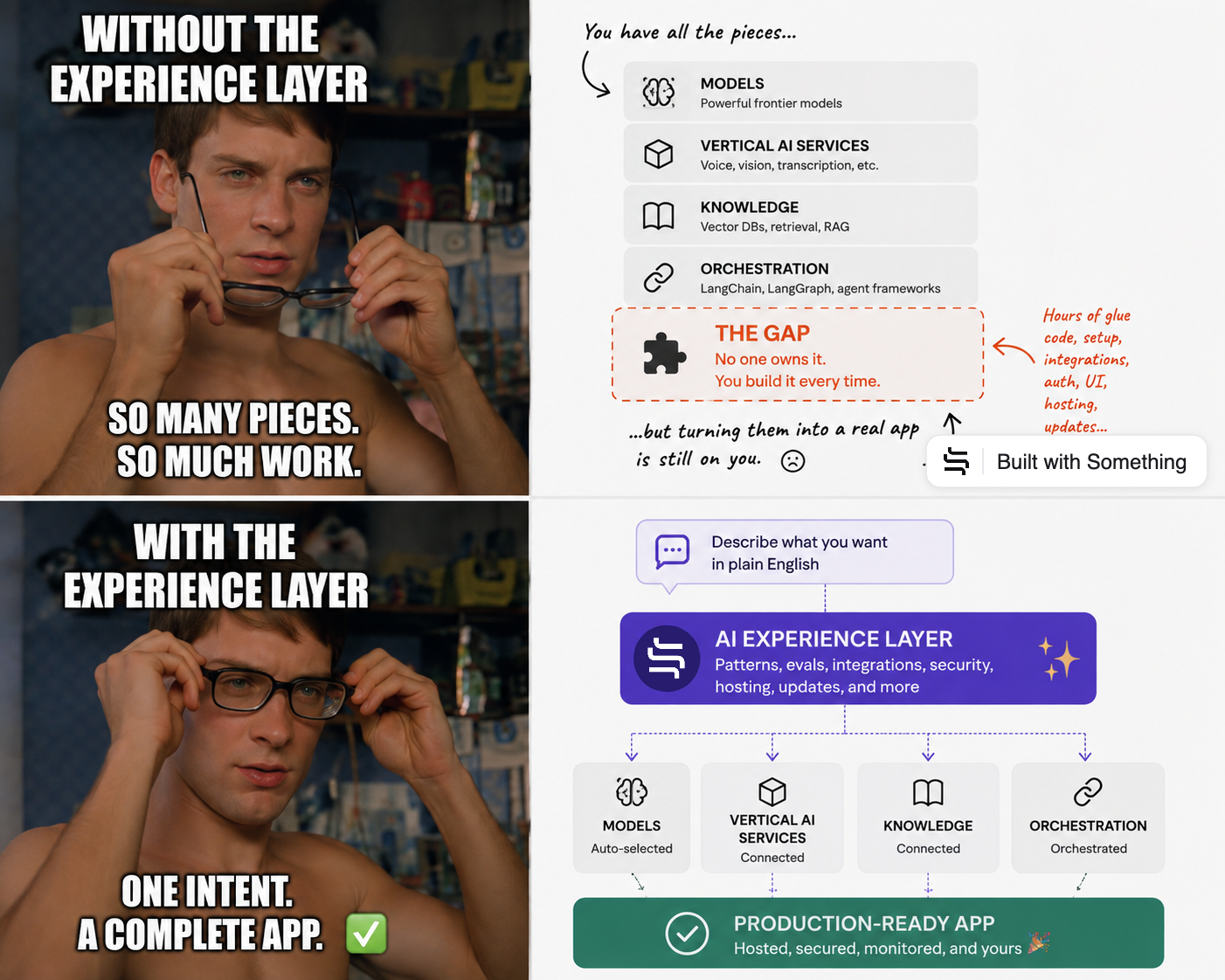
Because the apps run on the layer — hosted, integrated, observed — every app built can make the next one better.
Which onboarding flow actually gets users to connect their tools?
Which voice-agent script keeps callers on the line?
Which daily-brief format do people actually read?
Which integration combinations work securely, by default, every time?
Those answers accumulate.
Over time, they become three compounding assets:
- A library of proven AI-native experience patterns.
- An experimentation engine that tests those patterns across the whole fleet of apps.
- An integration graph of tool combinations known to work.
Security isn't a scan you run after generation. It's a property of patterns that have already survived production.
A code generator is a vending machine.
An experience layer is a compiler with a memory: plain English in, the best-known version of that app out — at a price you can predict.
What this looks like in practice
We started Something with agentic apps, because that's where the gap is widest.
People have already built things by describing them in a sentence:
- A voice sales agent with a phone number customers can actually call
- An email extractor and summarizer that turns an inbox into a daily brief
- A morning digest pulling from Stripe, Linear, and Slack
- Small, sharp utilities — an image upscaler, a video creation tool — with AI at the core
Different apps, same anatomy underneath.
An intent expressed in plain language.
The right models and vertical AI services, selected automatically.
A thousand-plus integrations, granted once and reused.
A real interface, not a chat box.
Voice as a first-class channel.
Hosting, domain, and updates handled.
And the code is yours to export whenever you want.
The user describes the outcome. The layer assembles everything below it — and stands behind it in production.
"Agentic" is where we begin, not where we end.
The experience layer applies to every AI-native application. Agents are simply the first category where the old way of building clearly cannot keep up.
Why this is a layer, not a feature
Every previous computing wave produced one.
Raw capability appeared first. Then a layer emerged that made it usable by orders of magnitude more people — and that layer captured the value.
Payments infrastructure existed before Stripe made it seven lines of code.
Commerce servers existed before Shopify let anyone open a store.
Databases existed before Salesforce.
AI is at the same moment.
Except there's one difference that makes this layer urgent rather than optional.
Analysts already project that a large share of new software will be created through natural language within a couple of years. In the same breath, they warn that citizen-built apps could multiply software defects dramatically.
Both predictions are probably right.
And that combination — enormous creation volume, unresolved production quality — is precisely the condition an experience layer exists to fix.
The winner here won't be whoever generates code fastest.
Code is becoming free.
It will be whoever knows, from evidence, what a great AI app is — and can produce it safely for anyone who can describe what they want.
English is becoming the programming language. Someone has to build its runtime.
So, what is the AI experience layer?
Here's our definition:
The AI experience layer (n.) — the layer of the AI stack that transforms underlying models, infrastructure, and services into complete, production-ready applications; characterized by plain-language creation, built-in integrations, interfaces, and hosting, secure-by-default patterns, predictable cost, and a feedback loop in which every deployed app improves the platform's knowledge of what works.
That's what we're building at Something.
We're in private beta. The first 100 founders get founder pricing, locked in.
Join the beta → https://trysomething.sh/beta
Something is supported by OpenAI, Anthropic, and Cartesia.
Sources referenced: Veracode 2025 GenAI Code Security Report and Spring 2026 update; CVE-2025-48757 disclosure (Matt Palmer, May 2025); public reporting on the Replit database incident (July 2025); company funding and revenue disclosures from Lovable, ElevenLabs, and Wix (2025–2026). [Link each on publication.]